5 Jul 2026 · 9 min read · Last updated 5 Jul 2026
Combi vs System Boiler: Which Is Best for Your Home?
By Carlton Fuller · Founder & Master Gas Engineer, 30 years' experience
TL;DR
A combi boiler heats water on demand straight from the mains - ideal for flats and homes with one bathroom. A system boiler stores hot water in a cylinder, so it can feed two or more showers at once - better for larger family homes. Your mains pressure, bathroom count and airing cupboard space decide it. We fit both and will tell you straight which one your home actually needs.
In the combi vs system boiler decision, a combi is best for flats and homes with one bathroom, because it heats water instantly from the mains with no cylinder. A system boiler is best for homes with two or more bathrooms, because its stored hot water can supply several outlets at once.
That is the short version, and for most households it is that simple. But the right choice also depends on your mains water pressure, how your family actually uses hot water, and what your house was built with in the first place - which matters a lot around here, where so much of the housing stock is Victorian terraces and 1930s semis. We have been installing both types across Surrey and South London since 1996, so below is the full comparison we talk customers through on a survey, without the fence-sitting.
How a combi boiler works
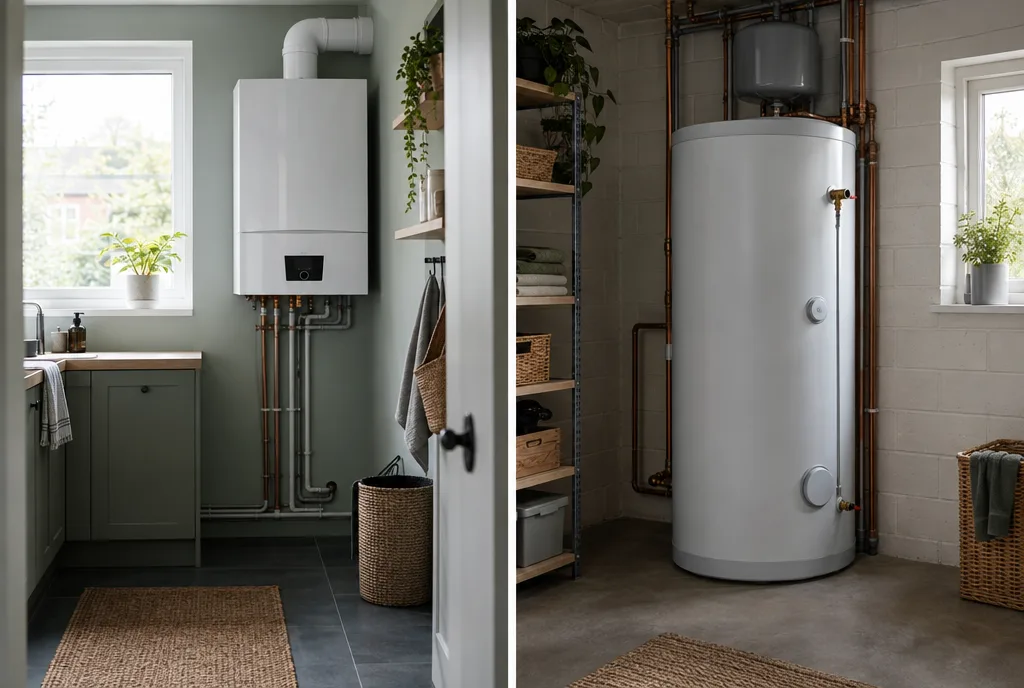
A combi (combination) boiler does two jobs from one wall-hung unit: central heating and instant hot water. There is no hot water cylinder and no tanks in the loft. When you open a hot tap, the boiler fires up and heats cold mains water on its way to the tap, in real time. Close the tap and it stops.
The upsides are obvious. You never run out of hot water because nothing is stored, you reclaim the airing cupboard, and you are not paying to keep a tank of water warm all day. Combis are also the cheapest boiler type to install because there is less kit and less pipework. It is why they are by far the most common boiler in UK homes - the Energy Saving Trust's boiler guide covers the types in more detail if you want the independent version.
A combi can only heat water as fast as the mains can deliver it. Run two showers at once and both turn lukewarm and feeble, because the boiler is splitting one flow of water between them. Everything a combi does is limited by your incoming mains flow rate and pressure - which is exactly what we measure on a survey before recommending one.
How a system boiler works
A system boiler heats your radiators directly, like a combi, but it does not make hot water on demand. Instead it heats a hot water cylinder - usually an unvented (pressurised) cylinder in an airing cupboard - and your taps draw from that store. The major components of the heating circuit (pump, expansion vessel) are built into the boiler, so unlike an old conventional setup there are no tanks in the loft.
Because the hot water is already made and sitting in the cylinder, a system boiler can feed two, three or four outlets at the same time at full temperature. Two showers running before school, someone filling the kitchen sink - no problem, until the cylinder runs down. A well-sized cylinder for a family of four or five typically holds 200 to 300 litres, and modern unvented cylinders reheat quickly and deliver hot water at mains pressure, so showers are strong.
There are trade-offs. You need somewhere to put the cylinder, the installation costs more, and you are storing hot water, so there is a small standing heat loss and you plan around the cylinder's capacity rather than having endless hot water. In practice, with a decent timer or smart control, a family rarely notices.
A quick note on heat-only (conventional) boilers
There is a third type: the heat-only or conventional boiler, with a hot water cylinder plus cold water tanks in the loft. It is the setup most Victorian terraces and 1930s semis around Croydon, Sutton and the Surrey towns were plumbed with originally. We still fit them, but usually only where the existing gravity-fed system is staying put - for example where mains pressure is too weak for an unvented cylinder, or where lots of old radiators could not take sealed-system pressure. For most replacements, the real decision today is combi vs system.
Combi vs system boiler: head-to-head comparison
Here is how the two types compare on the things customers actually ask us about. Installation figures are typical UK ranges - see our full guide to new boiler costs in 2026 for a proper breakdown of what drives the price.
| Factor | Combi boiler | System boiler |
|---|---|---|
| Hot water delivery | Instant, unlimited, but heated in real time | From a pre-heated cylinder, strong flow until the store runs down |
| Space needed | One wall-hung unit, no cylinder, no tanks | Boiler plus a cylinder (typically 150-300 litres) in a cupboard |
| Showers/bathrooms it suits | 1 bathroom; struggles with 2 showers at once | 2+ bathrooms; runs several outlets at full temperature |
| Mains pressure dependency | High - performance lives and dies by mains flow rate | Lower - the cylinder buffers demand (unvented still needs decent mains) |
| Typical installed cost (UK) | Around £1,800-£3,000 for a like-for-like swap | Around £2,500-£4,500 including cylinder work |
| Cylinder needed? | No | Yes - unvented cylinder, sized to the household |
| Running-cost profile | No stored water, so no standing heat loss | Small heat loss from the cylinder; efficient when sized and timed well |
Which boiler type suits which home?
This is where we stop hedging. Based on thirty years of fitting boilers in the local housing stock, here is what we would put in your home, by household type.
Flats and one-bathroom homes: combi, almost every time
If you live in a flat or a smaller terraced house with one bathroom, a combi is the right answer in nearly every case. You get your storage space back, installation is cheaper, and one bathroom means the combi's one-outlet-at-a-time limitation almost never bites. The only real exception is a flat with genuinely poor mains flow that cannot be improved - rare, but we do find it, and we will tell you if we do.
Victorian terraces and 1930s semis with one bathroom: usually combi
A huge share of the homes we work on in South London and East Surrey are Victorian terraces and 1930s three-bed semis, and most still have one bathroom. Converting these from an old heat-only system to a combi is our bread-and-butter job: the loft tanks go, the cylinder goes, and the airing cupboard becomes actual storage. One caveat specific to older terraces - some still have the original small-bore or even lead supply pipe from the street, which throttles mains flow. We measure the flow rate at the survey, because a combi on a starved main is a miserable thing. If the supply is poor and can't sensibly be upgraded, we will say so and recommend keeping stored hot water instead.
Extended semis and family homes with 2+ bathrooms: system boiler
If your home has two or more bathrooms that get used at the same time - the classic extended 1930s semi with a loft-conversion en-suite, or a larger detached family house - fit a system boiler with an unvented cylinder. No combi, however big, will run two showers well simultaneously; the physics of one mains feed does not allow it. Families of four or five with a morning shower queue are consistently happier with stored hot water. Both Vaillant and Worcester Bosch make excellent system boilers, and as a Vaillant Approved Installer we can offer Vaillant's 10-year parts and labour warranty on qualifying installations - our guide to the best boilers for 2026 compares the ranges.
The borderline case: 2 bathrooms, light use
A couple in a house with a bathroom and a rarely-used en-suite? A high-output combi (35kW+) on a strong main can be fine, and saves the cylinder space and cost. This is the one genuinely borderline case, and it turns on your measured mains flow rate and honest answers about how often both showers run at once. That is a survey conversation, not a guess.
Converting from one boiler type to the other
You are not locked into what you have. Both conversions are routine work for us, but they are bigger jobs than a like-for-like swap, so the cost and disruption are worth understanding up front.
- ◆System (or heat-only) to combi: the most common conversion. We remove the cylinder and any loft tanks, re-route hot water pipework, and fit the combi. Typical UK cost is around £2,500-£3,500 depending on pipework and boiler location. A straightforward conversion usually takes 1-2 days - our guide to how long a boiler installation takes sets out the timings.
- ◆Combi to system: less common, but the right move when a growing family adds a bathroom. We fit a system boiler plus a new unvented cylinder, which needs a cupboard and a discharge pipe run. Typical UK cost is around £3,000-£4,500 including the cylinder. Unvented cylinder work must be done by a suitably qualified installer, which we are.
- ◆Either way, the job must be carried out by a Gas Safe registered engineer - you can check any engineer's ID on the Gas Safe Register before letting them near your gas supply.
Going from stored hot water to a combi changes how the house feels. Showers now depend on the mains, so if a family member flushes a loo mid-shower on a marginal main, you will notice. Going the other way, from combi to cylinder, you gain simultaneous showers but give up a cupboard. Neither is wrong, and the survey is where we match the system to how your household actually lives.
Our honest decision framework
This checklist is the same logic we apply on every survey:
- ◆One bathroom (flat, terrace, standard semi): choose a combi. Cheaper to fit, no cylinder, endless hot water for one outlet at a time.
- ◆Two or more bathrooms in regular simultaneous use: choose a system boiler with an unvented cylinder. It is the only setup that runs multiple showers properly.
- ◆Two bathrooms but rarely used together: borderline - a high-output combi can work if your measured mains flow is strong; otherwise go system.
- ◆Weak mains supply that cannot be upgraded (some older terraces): keep stored hot water - a system or heat-only setup - regardless of bathroom count.
- ◆Planning a loft conversion or extension with an extra bathroom in the next few years: fit the system boiler now rather than paying for a second conversion later.
Whichever way it goes, we do a free survey first: we measure your mains flow and pressure, look at the existing pipework, talk through how you use hot water, and give you a fixed written quote with no surprises on the day. Most standard swaps are done in a single day. You can see how we price installation work on our pricing page, and everything we fit is covered by our boiler installation service across Surrey and South London.
Not sure whether your home needs a combi or a system boiler? Book a free survey and we will measure, recommend and quote - in writing, with no pressure.
Book a free boiler surveyFrequently asked
Is a combi or system boiler better for a 3-bed house?
It depends on bathrooms, not bedrooms. A 3-bed house with one bathroom is almost always better with a combi: cheaper to install, no cylinder, and unlimited hot water for one outlet at a time. A 3-bed with two bathrooms used at the same time is better served by a system boiler with a cylinder, because a combi cannot run two showers well simultaneously.
Can a combi boiler run two showers at once?
Not well. A combi heats water in real time from a single mains feed, so two showers running together share one flow of water and both go weak and lukewarm. A very high-output combi on an exceptionally strong main can just about manage brief overlaps, but if two showers regularly run at once, a system boiler with a hot water cylinder is the right choice.
How much does it cost to convert a system boiler to a combi?
A typical UK range is around £2,500 to £3,500. The job involves removing the hot water cylinder and any loft tanks, re-routing pipework and fitting the new combi, so it costs more than a like-for-like swap. The final price depends on where the boiler sits, the pipework condition and the boiler you choose. We confirm it with a free survey and a fixed written quote.
Do system boilers need a tank in the loft?
No. A system boiler runs on a sealed circuit with the pump and expansion vessel built in, so there are no loft tanks. It does need a hot water cylinder, usually an unvented one in an airing cupboard, fed directly from the mains. It is heat-only (conventional) boilers, the older setup, that use cold water storage tanks in the loft alongside the cylinder.
Does a combi boiler work with low water pressure?
Poorly. A combi depends entirely on your incoming mains flow and pressure, so on a weak supply you get feeble showers and slow-filling baths. Some older Victorian terraces still have narrow or lead supply pipes that throttle the flow. If the main cannot sensibly be upgraded, stored hot water from a system or heat-only setup is the better option, which is why we measure flow rate before recommending anything.
Which boiler type is cheaper to run, combi or system?
For like-for-like usage a combi has a slight edge, because it stores no hot water and so loses no standing heat from a cylinder. Modern unvented cylinders are very well insulated though, so on a properly sized and timed system the difference is modest. Fit, size and controls matter more to your bills than the boiler type itself, which is why sizing is part of our survey.
Related guides
Need a Gas Safe engineer?
Call 07956 876156 or request a callback - we cover South London and Surrey.